- Transformer manufacturers in China

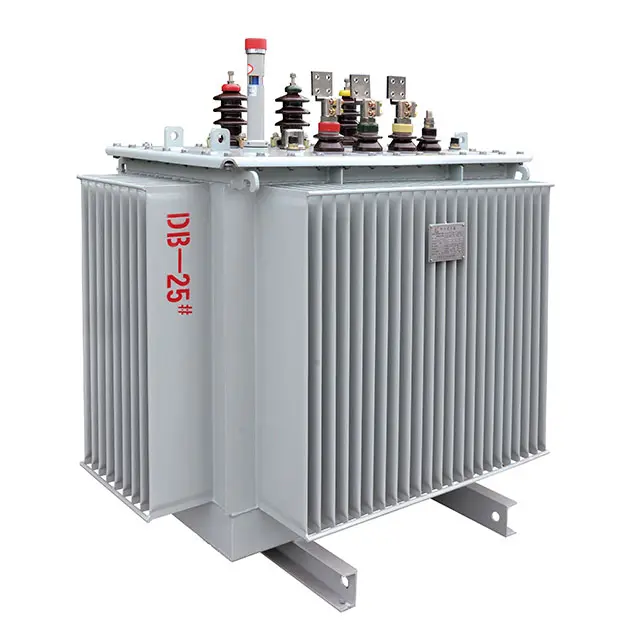
An oil-immersed distribution transformer (also called oil-filled distribution transformer or MV/LV step-down transformer) uses mineral insulating oil as both a dielectric and a cooling medium. The active part — silicon-steel core and copper or aluminum windings — is sealed inside a welded or corrugated steel tank filled with transformer oil. This construction is the standard for medium-voltage distribution networks worldwide because of its heat-dissipation efficiency, long service life, and field-proven reliability in outdoor and indoor substations.
The S20 and S11 designations identify the two efficiency classes offered in this product line: S20 is the high-efficiency tier and S11 is the standard-efficiency tier. The two series share the same mechanical and electrical platform; they differ in core material and loss level. All units are configured per IEC 60076 as the base standard, with options to comply with IEEE C57.12, DOE 2016, and EU regulation 548/2014 for the respective regional markets.
| Item | S20 Series | S11 Series |
|---|---|---|
| Efficiency tier | High efficiency | Standard efficiency |
| Typical compliance | IEC 60076 (Grade 1 equivalent), DOE 2016 Tier 2, EU Tier 2 | IEC 60076 (Grade 3 equivalent), DOE 2016 Tier 1 |
| No-load loss | Lower (approximately 30% below S11 reference) | Baseline |
| Load loss | Lower (approximately 20% below S11 reference) | Baseline |
| Best fit for | Continuous-load networks, regions with Tier 2 efficiency mandates | Standard distribution, light-load rural grids |
For sourcing: confirm the kVA rating, primary/secondary voltage, vector group, and efficiency tier. These are the universal terms used in international quotations.
Pad-mounted and substation installation in city grids, feeding commercial districts and mixed-use developments.
Pole-mounted single-phase and three-phase units for village electrification and agricultural loads.
Plant-level distribution for mining, cement, chemical, and metallurgical sites, often with forced-air cooling (ONAF).
Step-up transformer from solar or wind inverter output to MV grid, with Dyn11 vector group for harmonic tolerance.
Indoor substation installation with low-noise design.
Use this 5-step decision flow before contacting any manufacturer:
Three common tank designs are available:
Before shipment, every unit undergoes the following routine tests:
Oil-immersed transformers use mineral oil as insulation and coolant, allowing higher power capacity and outdoor installation. Dry-type transformers use solid insulation (epoxy resin or cast resin) and are typically used indoors where fire safety is critical.
Both are three-phase oil-immersed distribution transformers on the same platform. S20 is the high-efficiency tier with approximately 30% lower no-load loss and 20% lower load loss than S11. S11 is the standard-efficiency tier at lower cost.
European Union: Tier 2 under EU regulation 548/2014. United States: DOE 2016 Tier 2. Other markets may accept either tier; confirm with your local utility or regulatory body.
IEC markets: 6 / 10 / 11 / 20 / 33 kV primary, 0.4 kV secondary. ANSI / IEEE markets: 4.16 / 7.2 / 13.8 kV primary, 0.48 kV secondary. Dual-voltage and dual-secondary configurations are available on request.
ONAN (Oil Natural Air Natural) is passive cooling, suitable for standard installations. ONAF (Oil Natural Air Forced) adds fans to the radiators, increasing rated capacity by approximately 25% under the same physical size.
Yyn0: primary star with neutral, secondary star with neutral, zero phase displacement. Dyn11: primary delta, secondary star with neutral, 30° phase displacement. Dyn11 is preferred for unbalanced loads and harmonic tolerance, and is the common export choice for IEC markets.
A fully sealed tank with no oil conservator, filled with oil and a nitrogen cushion. It is maintenance-free and suited to humid, coastal, or pollution-prone sites. Typical power rating up to approximately 1600 kVA in this design.
An amorphous-core transformer uses amorphous metal strip instead of conventional silicon steel. No-load loss is reduced by approximately 70% compared with S9 baseline. It is suited to 24/7 lightly-loaded networks such as solar, wind, and standby power applications.
Standard: mineral oil per IEC 60296 (Nynas, Shell, or Mobil sourced). Optional: natural ester (Cargill FR3) or synthetic ester (MIDEL 7131) for fire-sensitive indoor installations.
Standard documentation includes routine test report, nameplate photograph, packing list, and operating manual. Type test report per IEC 60076 is provided on request, subject to order quantity and prior arrangement.
Send us your capacity (kVA), primary / secondary voltage, vector group, efficiency tier, and destination country. Our engineering team replies with a technical offer covering the standard specification, applicable standards, and available options.
Prefer email? Reach us at [email protected].
Technical content reviewed against IEC 60076, IEEE C57.12, EU 548/2014 and DOE 2016 requirements.